American Black Bear
Ursus americanus
Birds & Mammals
Coastal forest and forest edge
iNaturalist record: 2022
Meet this species
American black bears are part of the larger coastal forest ecosystem surrounding Glasgow Creek and Greene Point. They move across broad home ranges in search of seasonal foods and shelter, crossing forest, riparian areas and other connected habitats rather than remaining within a single ecological zone. A bear observation therefore represents much more than one charismatic animal: it is evidence that the estuary exists within a landscape large enough to support wide-ranging wildlife.
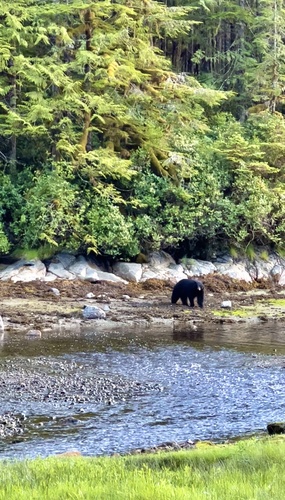
American black bear observed in the coastal forest landscape near Greene Point.
What to look for:
A large, powerful bear with rounded ears, a broad head and a short tail. Coat colour can vary considerably, from deep black through brown tones. Even when the animal itself is not seen, tracks, scat, claw marks, disturbed logs and other signs can reveal that bears are moving through the landscape.
Why It Matters Here:
Large mammals make the watershed-to-ocean connection tangible. Protecting the estuary cannot be separated completely from what happens in the surrounding forest, because wildlife moves through the same connected landscape that carries water, nutrients and organic matter toward Glasgow Creek and the sea.
Field Record
Documented at Greene Point through field observations and photographs recorded on iNaturalist.